
Stick Chairs 3.0
Another way forward with the form.

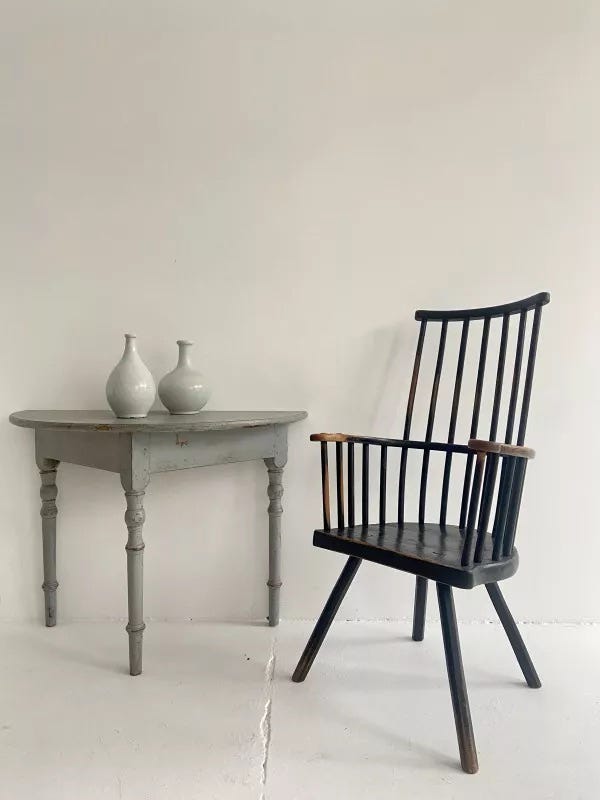
This week we plan to release a two-hour video of how Chris Williams builds a Welsh lobsterpot chair using naturally grown crooks from the hedge to make the arm. It’s a fascinating documentary of how his brain works and his hands think.
Naturally bent wood eliminates short grain in the armbow, making the arm far more durable, and it allows you at times to make an arm without a shoe/doubler. This is the method that Welsh chairmakers used for the very best chairs out there.
Chris switched to this approach years ago. The video and his forthcoming book, “One Square Mile,” will hold your hand as you walk in the hedgerows filled with bent arms (and combs).
For years, I’ve walked the streams and hills here in Kentucky to find similar pieces of bent wood that could be used in my chairs. It’s out there. I’ve had the most success finding the right shapes in Osage orange (Maclura pomifera). It tends to grow 90° crooks, but the wood is similar to cutting brass. It’s tough stuff. And heavy (0.83 to 0.86 specific gravity).
One of Lucy’s cousins has a farm nearby that has lots of this bent Osage, and we’re planning to get down there in the spring. So I hope to have a report on that trip in the coming months.
But today I wanted to show you how I harvest naturally curved wood from the lumberyard. I’ve been doing this for about five years with some success and have made maybe four or five chairs this way. I think of these chairs as Stick Chairs 3.0.
For me, Stick Chairs 1.0 were made with steambent or compwood arms. This is how I first learned to make stick chairs starting in about 2004.1 I still make some chairs this way. It’s a totally valid method. But I wanted to get away from steambending because of the extra equipment required and the difficulty of finding good bending stock that is straight and somewhat green.
Stick Chairs 2.0 are the chairs in “The Stick Chair Book.” These chairs are made with lumberyard wood and bench tools. Again, this is a totally valid way to make chairs – I’ve made hundreds of chairs this way. The compromise is that if you have a continuous armbow, you have to contend with a little short grain. I haven’t had an armbow break in service, but one of the symptoms of “Chair Disease” is that you lie awake at night worrying about the chairs you have built and sent to the far corners of the country. Still, I plan to make more chairs using these methods. If you are careful, you’ll be fine.
Enter Stick Chair 3.0, which was urged on by Chris Williams: Build chairs with no short grain and no steambending. I hope you’ll purchase and watch Chris’s video because the detail on his methods is remarkable. But me, I’m all about making chairmaking accessible. So if you want naturally bent wood, you should visit your local natural-edge slab superstore.
Even though I’m not a fan of waney-edge tables with hairpin legs, I still love to look at slabs because they show the crazy ways that trees can grow. And if you pay close attention, you’ll find your curved wood.


The easiest place to find it is in the crotch of the tree – where the main bole split into two or three smaller trunks. There might be a lot of confused grain around the crotch, but I can usually find a few good arms from a decent-sized crotch (boy, the search engine spiders are going to be weirded out by this entry).
Some trees, such as live oak, grow crooked as they get old. (But like Osage orange, the wood is not fun to work.) Then there are trees that grew in a field or next to a field. Or they grew in a cityscape. These trees weren’t striving straight up for the canopy like forest trees. So they can have some unusual shapes.
This week I picked up this slab of yellow pine that was a field tree in Greene County, Ohio. This tree had sort of a Jessica Rabbit shape to its trunk. And there is a lot of curved wood in that cartoon rabbit’s torso.
The slab was kiln dried, heavy and dense like maple. The tree grew slowly for a yellow pine (about 1" every 20 years). So the first step was to go all James Krenov on the thing and listen to it. To rub my hands over the grain and feel what the slab wanted to become.2
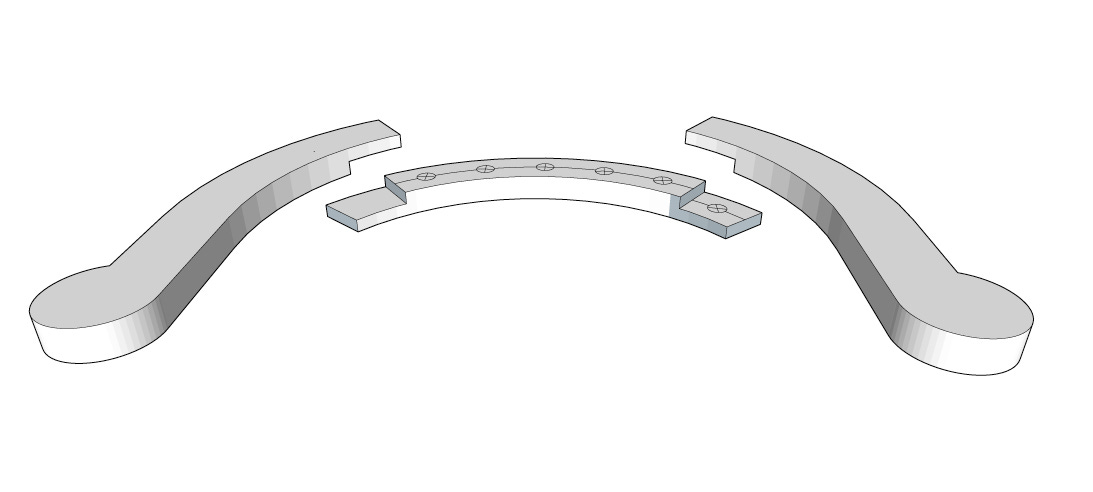
Then I made some arm templates that reflected the curves and radii I saw in its grain. I’ve have been eager to build a version of a Welsh comb-back (shown at the top of this entry) that has a scarf-jointed arm with no shoe. After an afternoon of drawing, I found the shapes I needed in the slab.
Keep reading with a 7-day free trial
Subscribe to The American Peasant to keep reading this post and get 7 days of free access to the full post archives.